Maps of Nowhere: Inside the Online Communities Charting Worlds That Don't Exist
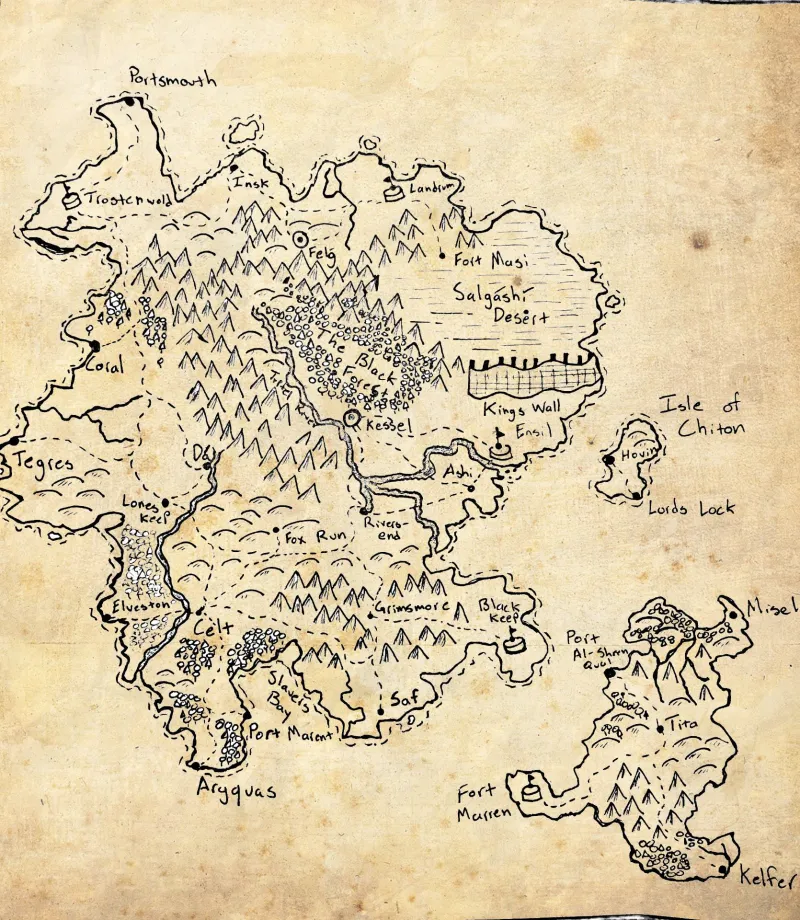
Photo: hand drawn fantasy map parchment fictional world cartography, via fiverr-res.cloudinary.com
Open a map and you expect it to tell you where things are. That's the deal. Latitude, longitude, roads that go somewhere, borders that mean something. Maps are supposed to be documents of reality.
But spend enough time in the stranger quadrants of the internet and you'll find a different kind of cartography — one that has nothing to do with the world as it exists and everything to do with the world as someone imagined it could be. These are the maps of nowhere, and the communities building them are doing something quietly extraordinary.
The Worldbuilders at the Edge of the Map
The subreddit r/worldbuilding has over a million members. r/imaginarymaps sits at several hundred thousand. Across these spaces and dozens of smaller forums, Discord servers, and personal project sites, thousands of people are engaged in what might be called speculative cartography — the art of making maps for places that don't exist, never existed, or existed only in an alternate timeline where things went differently.
The range of what gets created here is genuinely staggering. There are alternate-history maps where the Confederacy won, where the Roman Empire never fell, where Indigenous nations retained sovereignty over North America. There are fantasy continent maps with hand-lettered place names and carefully drawn mountain ranges. There are maps of future Earths, flooded or frozen or carved into city-states. There are fictional subway systems for cities that don't have subways, or don't exist at all.
And then there are the really strange ones — maps of impossible geometries, cities that fold back on themselves, coastlines that form faces or words when you zoom out far enough.
"A map is a way of saying 'this place is real enough to be worth documenting,'" explains one prolific contributor to the imaginary maps community who goes by Veradis online and has been building the same fictional nation — a loosely Ottoman-inspired coastal empire called Kesaveth — for going on six years. "When you make a map of something, you're making an argument that it deserves to exist."
Alternate History as Emotional Geography
A significant chunk of this creative output falls into the alternate-history genre, and it's worth sitting with why that particular mode resonates so deeply with American creators specifically. The US has a fraught relationship with its own geography — borders drawn through violence, place names layered over erased ones, a national mythology that keeps colliding with inconvenient historical facts.
Alternate-history mapping lets people engage with that complexity obliquely. Some creators are explicitly reckoning with it — building maps of North America where colonization went differently, where Indigenous confederacies expanded rather than contracted, where the land's political shape reflects something closer to its pre-contact reality. Others are processing different kinds of grief: for the South that some imagined it could have been, or for a unified Korea, or for an undivided Ireland.
"There's something about the map format that makes it feel safer to explore uncomfortable ideas," says a researcher who studies online creative communities and asked not to be named. "It's one step removed from direct argument. You're not saying 'this is what should have happened.' You're just drawing a line and seeing where it goes."
Not all of it is that earnest, of course. A lot of it is just fun — the same impulse that made people spend hundreds of hours in Civilization V, redrawing the world according to their own strategic logic.
The ARG Cartographers
Some of the most compelling projects blur the line between fictional map-making and alternate reality games. These are projects that present themselves as documentation of real places — complete with fabricated historical records, fake Wikipedia-style articles, and carefully constructed visual aesthetics designed to make the unreal feel plausible.
One of the most celebrated examples in recent memory was the Gerasene Project, a collaborative ARG that ran for about eighteen months and involved a fictional archipelago nation with its own language, currency, and decades of invented political history. Participants contributed to an ever-expanding wiki, argued in-character about the nation's fictional elections, and submitted artwork, music, and literature supposedly produced by the archipelago's fictional artists.
From the outside, it looked like a research archive for a place that didn't exist. From the inside, participants describe it as one of the most genuinely absorbing creative experiences they'd had online — a collective act of world-generation that felt meaningfully different from conventional fandom or roleplay.
"What made it work was the commitment to the geography," says one former participant. "The islands had a physical logic. You could look at the map and understand why the northern settlements were fishing communities and why the capital ended up where it did. The place had a body. Everything else grew out of that."
Interactive Maps and the Texture of Invented Places
Beyond the forum posts and subreddit threads, a growing number of creators are building interactive digital maps — using tools like Inkarnate, Wonderdraft, or custom-coded web projects to create fictional geographies that users can actually navigate.
Some of these have become destinations in their own right. There are interactive maps of elaborate fantasy worlds with hundreds of named locations, each with its own lore entry. There are alternate-history maps where clicking on a city takes you to a page of fabricated historical documents. There are procedurally generated planet maps that spit out new worlds every time you load the page, each one technically unique and technically uninhabited.
The craft that goes into these projects is often remarkable. Serious practitioners study real-world geography to make their invented places feel plausible — learning how river systems actually develop, how mountain ranges affect climate, how trade routes shape where cities grow. The goal is a map that feels like it could be real, that has the internal logic of a place that developed organically rather than being designed.
"Bad fictional maps are full of mountains in places that don't make geological sense, rivers that flow uphill, cities in locations that no actual civilization would choose," explains Veradis. "When I look at a map and the geography is coherent, I feel like the person making it actually cares. They're not just decorating. They're building."
Why Maps, and Why Now
There's something worth noting about the timing of all this. These communities have grown substantially in the last decade, and especially in the last five years. It's tempting to read something into that — to suggest that people are retreating into invented geographies because the real one has become too destabilizing, too contested, too full of borders that feel arbitrary and names that feel wrong.
Maybe. Or maybe it's simpler than that. Maps have always been objects of imagination as much as documentation. The blank spaces at the edges of old charts — here be dragons — were invitations as much as admissions of ignorance. The impulse to fill in the unknown with something invented is as old as cartography itself.
What the internet has done is connect the people who feel that impulse and give them tools to act on it collaboratively. The maps of nowhere are being drawn by real people, in real communities, with real investment in the places they're creating.
That might be the most interesting geography of all — not the fictional coastlines and invented capitals, but the actual human terrain of connection and creativity that surrounds them. No map required.